Skip to content
ProductManagement.com.br

Um lugar aberto à discussão sobre produtos digitais

  • Product Management
    • Product Discovery – Dicas e Passos.
    • O Product Owner e o Business Analyst
    • Refinement Meeting: Por que e como fazer?
    • Visão geral do PO em projeto Ágil
    • Perfis legais para seguir no Twitter
  • Scrum
    • Scrum, o primeiro contato!
    • Ágil. Porque tantas tentativas falham?
    • O Product Owner e o Business Analyst
    • Ágil. Gestão do conhecimento, escopo, documentação, testes, falhas e mais…
    • Scrum. Gestão do conhecimento e mudanças de escopo
    • Ágil. Um pouco sobre documentação de regras, testes e comunicação
    • Refinement Meeting: Por que e como fazer?
    • Refinement Meeting: Respondendo as 6 dúvidas iniciais
    • Características de um bom Product Backlog – DEEP
    • Perfis legais para seguir no Twitter
  • English
    • Agile Product Ownership in a nutshell
    • Agile. Why so many projects fail?
    • Grooming the Product Backlog: Answering 6 initial questions
    • Great profiles to follow on Twitter
ProductManagement.com.br

Um lugar aberto à discussão sobre produtos digitais

Agile. Why so many projects fail?

Daniel Baldini, February 23, 2017February 28, 2017

The answer is quite easy and you should know, but I’ll show you a slide to explain it better.

In a previous post, I have shown what I understand to be the greatest difference between a Traditional (Waterfall) Project and an Agile Project.

When writing, the difference is tiny. But there is a big gap when we talk thinking in the cultural aspect of them.

I have joined in a Webinar from Scrumdotorg which was presented by rjocham – two great profiles to follow on Twitter. 

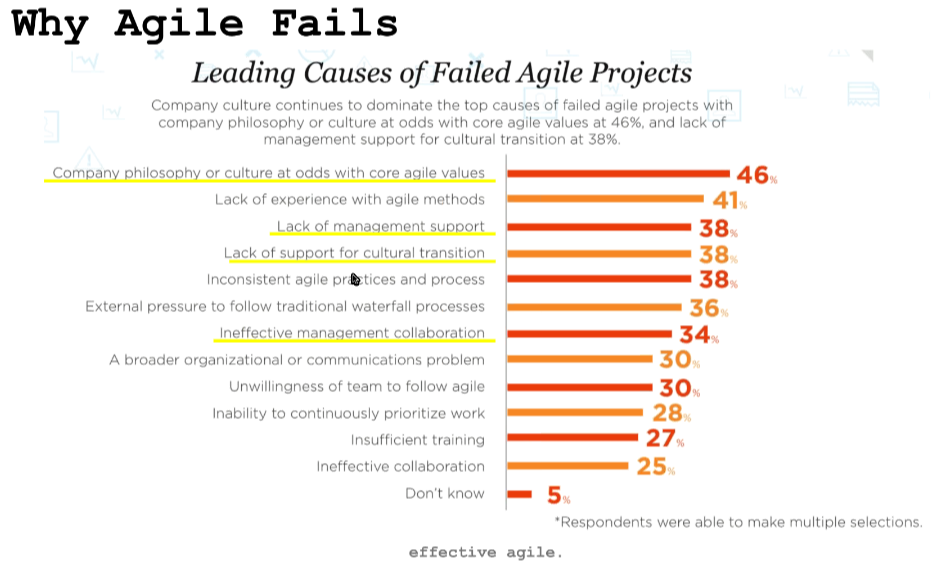
Ralph Jocham showed a slide in which we could see that 5 of the top 7 main reasons for failed Agile Projects – in some perspective – are related a change in the company culture. 

The main reason is that 46% of people believe that the Company philosophy or culture is at odd with core agile values. 

Other reasons are:

– 38% cite lack of management support

– 38% lack of support for cultural transition

– 36% external pressure to follow traditional waterfall process – I have added this one because I think this is a kind of culture changing resistance.

– 34% ineffective management collaboration

Considering these data and knowing how much we as a human race are resistant to change, it is not too difficult to understand the reason for so many agile projects failures.

In the video Agile Product Ownership in a nutshell  one of the phrases in the video says that:

If your organization doesn’t like truth and honesty, probably won’t like Agile.

To sum up:  According to this survey, a huge portion of Agile projects fails because the company board does not support and/or is not committed to change the company culture.


Below I left you the original slide, the Webinar and the link to access it on Scrum.org.

SLIDE ORIGINAL:
WEBINAR

URL NO SCRUM.ORG

https://www.scrum.org/resources/scrumpulse-22-management-30-scrum-how-become-next-generation-agile-leader

[Portuguese Version]

English Scrum

Post navigation

Previous post
Next post

Related Posts

Ágil. Gestão do conhecimento, escopo, documentação, testes, falhas e mais…

March 5, 2017March 5, 2017

Há cerca de 1 semana postei no LinkedIn meu artigo Ágil. Porque tantas tentativas falham? e tive a honra de ter este post compartilhado por uma amiga e grande profissional da área de Testes de Software. Em seu compartilhamento – que pode ser acessado por aqui – ela fez 5 questionamentos a…

Read More

Scrum. Gestão do conhecimento e mudanças de escopo

March 5, 2017March 21, 2017

No mundo Lean/Ágil ao contrário do modelo tradicional, o projeto não tem um “conjunto de features pré-estabelecidas” e a partir destas o produto começa a ser desenvolvido visando desenvolver estas funcionalidades. Tá bom, então como funciona? A empresa possui a Visão do Produto, que nada mais é do que o…

Read More

Scrum, o primeiro contato!

February 21, 2017February 28, 2017

Para aqueles acostumados com os modelos tradicionais de projeto o primeiro contato com o Scrum é assustador. Para ilustrar isso queria apresentar algumas questões que defino como “a diferença básica” entre eles. Modelo tradicional Organograma do projeto O objetivo do organograma é estabelecer a hierarquia e linhas de reports. É análogo…

Read More

Últimos posts

  • Product Discovery – Dicas e Passos.
  • Refinement Meeting: Por que e como fazer?
  • O Product Owner e o Business Analyst
  • Características de um bom Product Backlog – DEEP
  • Ágil. Gestão do conhecimento, escopo, documentação, testes, falhas e mais…

Comentários

  • Urânia Reis on Ágil. Porque tantas tentativas falham?
©2026 ProductManagement.com.br | WordPress Theme by SuperbThemes